

Creatopy is now The Brief.

Creatopy is now The Brief.

If you've ever paused before hitting export because you weren't sure the credits were worth it, you're not alone. That hesitation is exactly what we set out to fix. We removed credit-based pricing, tested what happened under real workloads, and the results reshaped how we think about the entire model. Here's the full story.
For years, creative SaaS worked like this: you subscribe, you get a bucket of credits, and you spend your workday watching that number go down. Every AI generation, every export, every batch takes another tick off the counter. At some point you're not thinking about the campaign anymore. You're thinking about the balance.
We lived with this model at The Brief for a while. And we kept hearing the same things from users: "I stopped mid-project because I didn't want to waste credits on a variation I wasn't sure about." Or simply: "exports cost too many credits." People were doing the creative work but hesitating to actually finish and ship it because the export itself felt expensive. That shouldn't happen in a creative tool. The whole point of AI-powered production is to explore more, test more, move faster. Credits do the opposite. They make people hesitate.
So we redesigned pricing from scratch. Not because the industry told us to, but because the old model was actively working against how creative teams actually work.
Here's what actually changes for you: you open the Ad Studio, build your campaign, export it. No credit counter, no mental math about whether this batch of 15 banner sizes is "worth it." You just work.
In normal workflows, you won't hit limits. A team producing 10 to 20 assets per week, running regular campaign cycles, exporting across multiple sizes and formats, that all falls well within what the platform supports without any interruption. Even during peak campaign bursts, most users stay in the "feels unlimited" range.
How it works behind the scenes: instead of giving you a visible credit balance to manage, the platform monitors usage in the background and only introduces soft limits when activity goes significantly above normal production patterns. You don't need to track this or think about it. If you're working normally, you'll never notice it's there.
Creative production is unpredictable, and that's fine. Some weeks you produce five assets. Other weeks a product launch lands and suddenly you need fifty. A credit system punishes that second week. Ours is designed to absorb it.
We didn't ship this until we saw how it behaves under real workloads. We removed credit consumption on exports for self-serve users and tracked what happened across real production workflows.
Activation (users going from creating an asset to actually exporting it) jumped 21%. Cancellation intent dropped by nearly 78%. And the concern that always comes up when you remove limits, that users will abuse the system, just didn't happen. Usage went up, but within reasonable bounds.
In practice, what this means for you: the people who were already doing the work started finishing it. They weren't creating more recklessly or burning through resources. They were exporting the campaigns they'd already built instead of second-guessing whether the export was "worth" the credits. The friction was the only thing holding them back.
We still monitor usage internally, cost controls are still in place, enterprise contracts haven't changed. You won't need to manage or monitor any of this. If your production is within normal patterns, the system stays invisible.
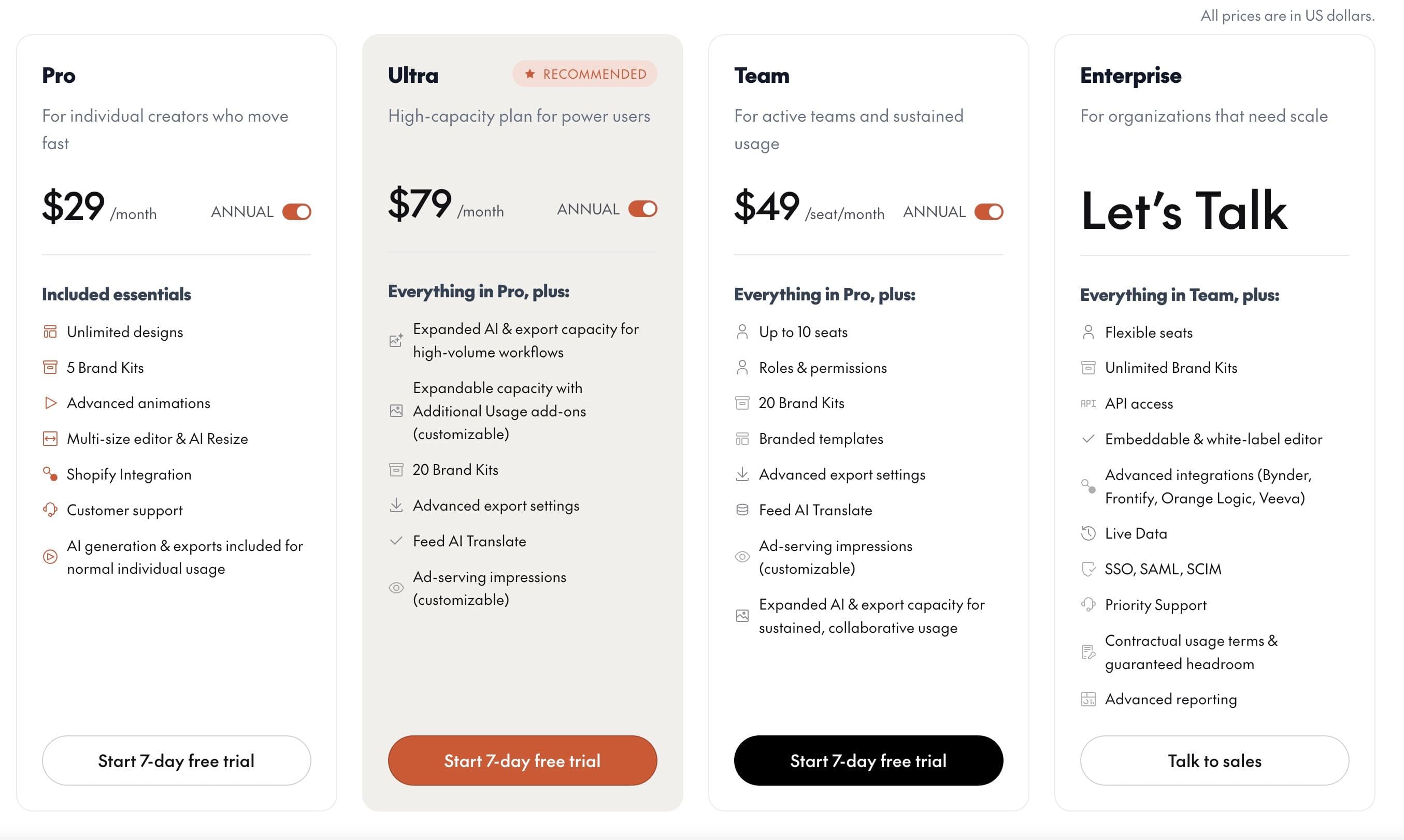
Most users won't hit a ceiling on Pro. But some users consistently operate at a level where "normal production workflows" just doesn't describe what they're doing.
Ultra is for those people. Not teams (that's what Team and Enterprise are for), but individual creators who generate a high volume of AI content as their main daily activity. The freelance designer juggling three client accounts. The performance marketer running weekly creative refreshes across multiple channels. The content creator who treats batch generation as a default, not a once-in-a-while thing.
Ultra gives you significantly more AI generation and export capacity than Pro. If you're on Pro and you keep bumping into capacity signals, Ultra's the natural next step. More headroom, no team-plan overhead. And if your needs vary month to month, add-ons let you scale capacity without switching plans entirely.
The progression works like this: Pro for regular creative workflows, Ultra for high-volume individual production, Team for collaboration, Enterprise for organizations that need governance and reporting at scale.
This isn't unique to The Brief. AI changed the economics of software fundamentally. Every generation, every export, every brand-compliance check runs a model, and models cost real money in compute. Creative workloads (images, video, multi-format layouts) are among the most expensive to run.
The result: the entire industry is moving toward tiered access. Claude Max is $100 to $200/month. ChatGPT Pro is $200/month. Gemini Ultra is $250/month. As Ars Technica noted, the computing costs are genuinely high. With 58% of US small businesses already using generative AI according to the U.S. Chamber of Commerce, the user base has moved well past the "$20 for unlimited everything" phase. The pattern now is an accessible entry point for regular use, and a professional tier for power users who need full capacity all day.
The Brief follows that same logic. But with a key difference.
Most platforms handle the transition by hiding the limits. You subscribe, you feel like access is unlimited, and then you hit a wall mid-afternoon during a deadline sprint. The platform nudges you to upgrade at the exact moment you are most frustrated and most pressured.
We didn't want to build that experience. The rolling-window throttle model, where your effective capacity shrinks during peak hours without warning, erodes trust. It turns the tool into something you work around instead of something you work with.
Our approach is different. Pro plans support normal production workflows comfortably, and soft limits only kick in when usage goes significantly above typical patterns. Most customers never see them. When they do, the signal is pretty clear: you're a power user, and Ultra was built for exactly your workflow.
No invisible ceilings. No mid-sprint surprises. The upgrade path exists because your needs are real, not because we engineered a pressure moment.
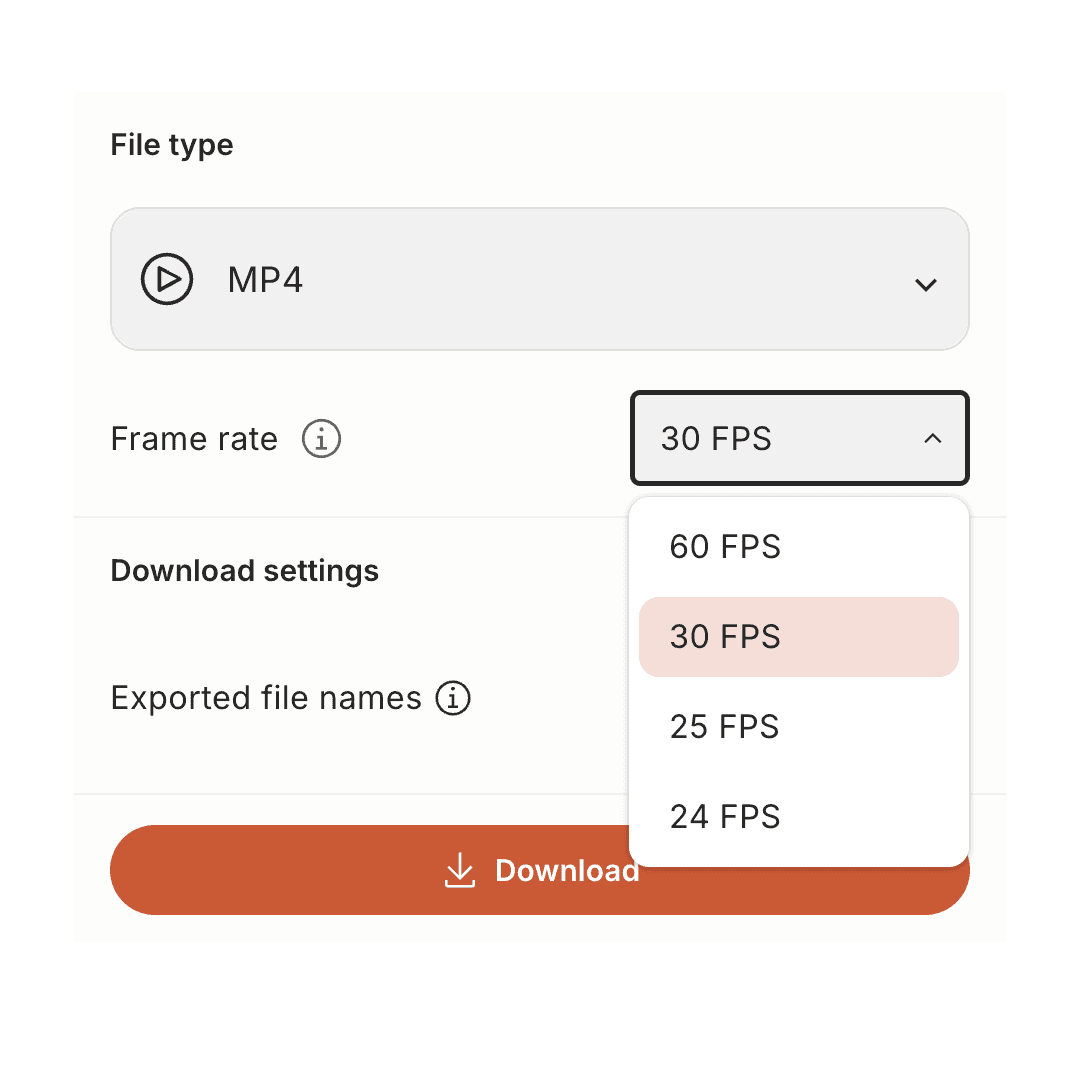
Your daily workflow in the Ad Studio doesn't change. You still build campaigns the same way, use the same flows, export to the same channels. What changes is what happens around the edges, the moments where credits used to slow you down.
Concretely: you run a batch of 15 banner sizes and you don't check your balance before hitting export. You test three different headline variations in a flow instead of picking one to save credits. When a client asks for "a few more options," you generate them without doing mental math first. Your campaign goes live this week, not next month when credits reset.
Your pricing path also gets simpler. If you're a solo creator or freelancer, Pro covers regular production and Ultra is there if you scale up. If you're part of a team, Team and Enterprise handle collaboration, permissions, and reporting. You don't need to game the system or time your heaviest work around billing cycles.
And if you're running the kind of operation where one person with AI is doing what used to take a full team, Ultra means the tool keeps up with you, not the other way around.
The economics of AI-powered creative production are still evolving. As The Brief's engine gets smarter (brand memory that improves with every campaign, flows that coordinate multi-channel launches, AI that actually learns from what's working), the value per generation goes up alongside the compute required to deliver it.
We designed pricing that can grow with that trajectory. Not by stacking more credit tiers and usage dashboards, but by keeping the experience simple: create freely, the platform scales with you.
Ultra isn't a price hike. It's a recognition that professional creative production deserves professional infrastructure, without the friction of managing it.
Let's put these insights into action. Build, scale, and automate campaigns with AI-powered workflows.

