

Creatopy is now The Brief.

Creatopy is now The Brief.

Oh, no… not that ad again. It’s so dull and meaningless.
That’s the last thing you want people to say about the ads you create.
This is why you need fail-proof ads to make your audience relate to your message, then click on them to see more about what you have to offer.
But this may be difficult to achieve because it takes hours of research, planning, and implementation.
What if there would be an easier way to gather the inspiration to create impactful ads?
There is. And it’s called an advertising canvas.
Mix that with your canvas for branding, and you've got yourself a recipe for ads that are not only on-point but also unique.
Let’s explore what a canvas is and how to make a canvas for your marketing campaigns.
An advertising canvas is a collage of visual elements such as images, typography, descriptions, and other elements that will guide your process in designing ads.
Advertising canvas are great to use for one single ad but also for extensive campaigns that include more than one ad combined with visuals for social media or print. It's a beneficial asset because it helps you stay consistent throughout all platforms and billboards.
You can also create a brand canvas (if you don’t have one already) and let it inspire your ad canvas.
There are two types of ad canvas: digital or physical. It’s completely up to you and your working style to choose the one that best fits your marketing campaigns.
There are many sources online that you can use to search for elements to include in your ad canvas.
Pinterest is one amazing place where you can find anything you're looking for. The platform also allows you to create your own board of inspiration, which you can even share with your team and just keep it private.
Moreover, you can search for imagery on websites that offer free stock photos and save those on your computer.
But since it’s easier to keep everything in one digital place and also be able to share the inspiration with your team, you can save all these elements to The Brief and use our platform as a canvas maker. You can have all the elements at hand in a Brand Kit.
If you want to get all Mad Men about it, you can also make a physical board. Here are some canvas examples straight from the TV series.


Get inspired by magazines, newspapers, or drawings, which you can cut out and glue onto your canvas. You can go even further and search for ideas through your own photos or books.
Anything related to your campaign message can be a great piece of inspiration.
If you want to stick to the physical canvas, you can create one starting from a collage that you can use as a canvas template in The Brief, then print it.
Now that you know what a canvas is, let’s see why it’s useful to create one.
A canvas design can help you when you have too many ideas and want to get them organized, or you don't really have any, and you want to gather a few assets in the same place to get you inspired.
An advertising canvas is also a great way to present your pitch to your team members or clients who need to approve the look and feel of the future ad campaign.
Besides these, a marketing campaign canvas is useful whenever you need to:
For someone who cares about how their ads look, gathering all the ideas and then designing them can take time.
An advertising canvas helps you gather everything in one place to recreate the look and feel of an ad, which you can share with anyone for approval or feedback.
This process helps you get everyone on board, so there’s no time wasted with designing ads that you won’t use in the end.
You can create a brand identity canvas with all the useful assets to always have them at hand and a marketing campaign canvas for specific ads. While the first one is somehow a more permanent thing, you can create as many marketing campaign canvas as you wish.
Then, it’s easier to mix and match the brand identity canvas with other ideas. In this way, you can rest assured that your ads will be consistent and relevant to your brand.
When it comes to creating ads, there are a few people involved in the process. We’re referring to copywriters, designers, PPC specialists, and maybe some other marketing specialists. They all need to know the direction of the ad campaigns to work together harmoniously and productively.
And an advertising canvas is doing exactly that.
You’ll help everyone understand what they have to do next.
With an ad canvas, and even better, with a canvas for branding combined with an advertising one, you’ll also ensure flawless communication between departments and, if necessary, people outside the company.
In the advertising world, you always have to come up with fresh ideas and concepts. And this may not always be easy since no one can force creativity and inspiration.
But you can nurture it.
In the process of learning how to be more creative, it’s a great idea to design a digital canvas or a palpable one.
The research and the assembling part will inspire you. Then, when everything is ready, even a glance at your advertising and brand canvas will bring everything into focus and spark ideas worthy of being turned into ads.
A company that knows its brand identity, values, and culture, probably already has a brand canvas. And since most, if not all the ads, have branded elements, it's equally useful to have an advertising board at hand as well.
An ad canvas is a guide that keeps you on track and focused on your brand identity. In this way, you'll never forget to include essential elements in your ads.
This means that by putting a business canvas together with an ad canvas with ideas, you can hit the mother lode of great ads.
Before creating a canvas, you should define your audience (if you haven’t done that already) to know who you're building your ads for.
This process will guide your entire ad strategy, and it’s essential to understand your potential customers in order to connect with them.
Once you know the style and approach you should adopt in your ads, you can create your advertising canvas.
To know how to make a canvas, we should see what it contains. Keep in mind that not all ads are the same, and thus your ad canvas will vary depending on your project.
Also, try to stay true to your message and don’t include elements just because you like them. Always ask yourself if the images or messages you like are relevant to the communication strategy. You can always save and use them later.
So, here is the anatomy of an ad canvas.
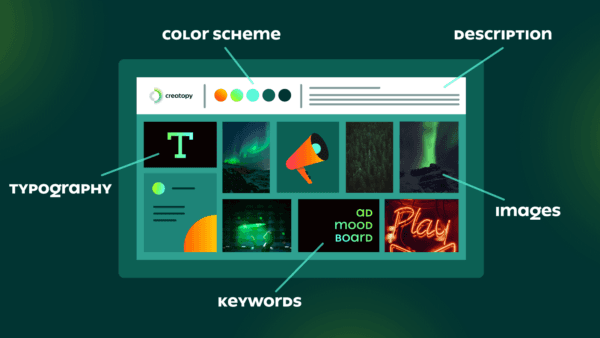
Choosing colors to include in your canvas design is crucial, and you have to consider more than just one aspect. Maybe you can first answer a few questions like:
The colors you choose for your marketing campaigns will make or break your ad designs. This is why you should carefully consider the color theory before starting to work on your campaigns.
Essentially, the colors you include in your canvas design should help your message get through to your audience while being true to your brand identity.
Think of the look and feel you're trying to recreate with your ads. Go for bright colors if you're designing ads for a children's brand or natural, pastel colors for skincare products to illustrate the idea of cleanliness and freshness.
Like Geek&Gorgeous did with this Facebook ad.

So, whatever color palette you pick for your ads, make sure to include it in the ad canvas.
All the visual aspects you include in your ad are essential, but you have to state your message clearly using words.
Add words to your advertising canvas that you wish to include in your headline and copy. They can be related to your brand identity, values, specific for a feature or product, or even quotes.
Besides these, you should also include the font(s) you wish to use for your message.
Including keywords in your canvas template is helpful because it draws a clearer picture of your idea based on a specific target audience, industry, products, or features.
Plus, it may come in handy when writing the copy for the ad. You can include those keywords to address people's search queries directly.
Adding a description to your advertising canvas is always a good idea. It will help you, especially when you have to send the pitch to someone else to understand the ad's direction.
Top it off with the keywords mentioned before, and there won't be any confusion regarding the main message of the marketing campaign.
You have colors, keywords, and a brief description, but you can always add images, illustrations, or icons to your ad canvas. Anything you feel that will help your ad's design and speak to your target audience.
When it comes to photos, you can add branding photography, or if you follow a few best practices for using stock photos, you can always rely on them. Stock photos can be a gold mine.
To better understand this, I can give you a canvas example. Let's say you're advertising for children's toys. Besides the warm, pastel colors you're going to add to the canvas, you can include stock photos of children playing with toys.
Textures and patterns can help you style or add depth and movement to your ad design.
If you have a digital canvas, you can easily search for textures to add to your ad design background.
On the other hand, if you choose to create a physical canvas, go ahead and search for materials such as paper with texture, fabric, or even organic elements such as flowers to pin them on the board.
You can always insert a bit of figurative speech, or why not, some visual metaphors to suggest what you would otherwise say literally.
Visual metaphors are creative representations of concepts, persons, places, things, or ideas using analogy or associations, and you can use them to give a more creative profundity to your designs.
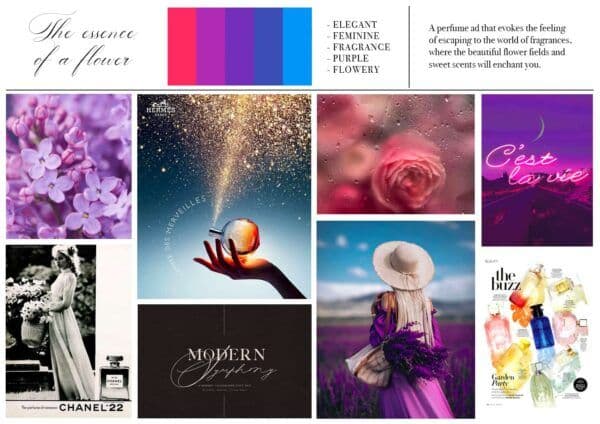
To better understand how advertising canvas should look, I asked for examples from reliable sources—two professional designers.
The first one is created by talented Maryia Zhaunova for a STUDS campaign, an earring and piercing brand. She was gathering inspiration to bring a colorful and crisp look to their campaign, with fresh elements and bold typography that would convince anyone to give a proper gaze to these products.

The second one is made by our gifted designer, Gyongyi Balogh. She’s the one that creates all the great featured images for our blog articles, and I asked her to imagine an ad canvas. So, she designed this one, which would fit perfectly for a delicate perfume ad.
Creating an advertising canvas is an effective way to ensure that your ads look precisely how you want them to. A canvas helps you preserve all the good ideas that come during the research process and also gives you more inspiration along the way.
If you want to start designing your ad canvas, but you don't have any canvas ideas just yet, go to The Brief and use our platform as your canvas maker.
Let's put these insights into action. Build, scale, and automate campaigns with AI-powered workflows.


Diana Bolboaca
Oct 11, 2019 - 8 min read
