In 2025, marketers didn’t slow down. They hit the gas.
Across campaigns created on The Brief, teams shipped millions of ads, leaned into templates and creative automation, and increasingly used AI for product photography and video.
About the dataset
“The State of Ad Creation 2026” is based on aggregated, anonymized data from The Brief platform across January 2024 – November 2025, including:
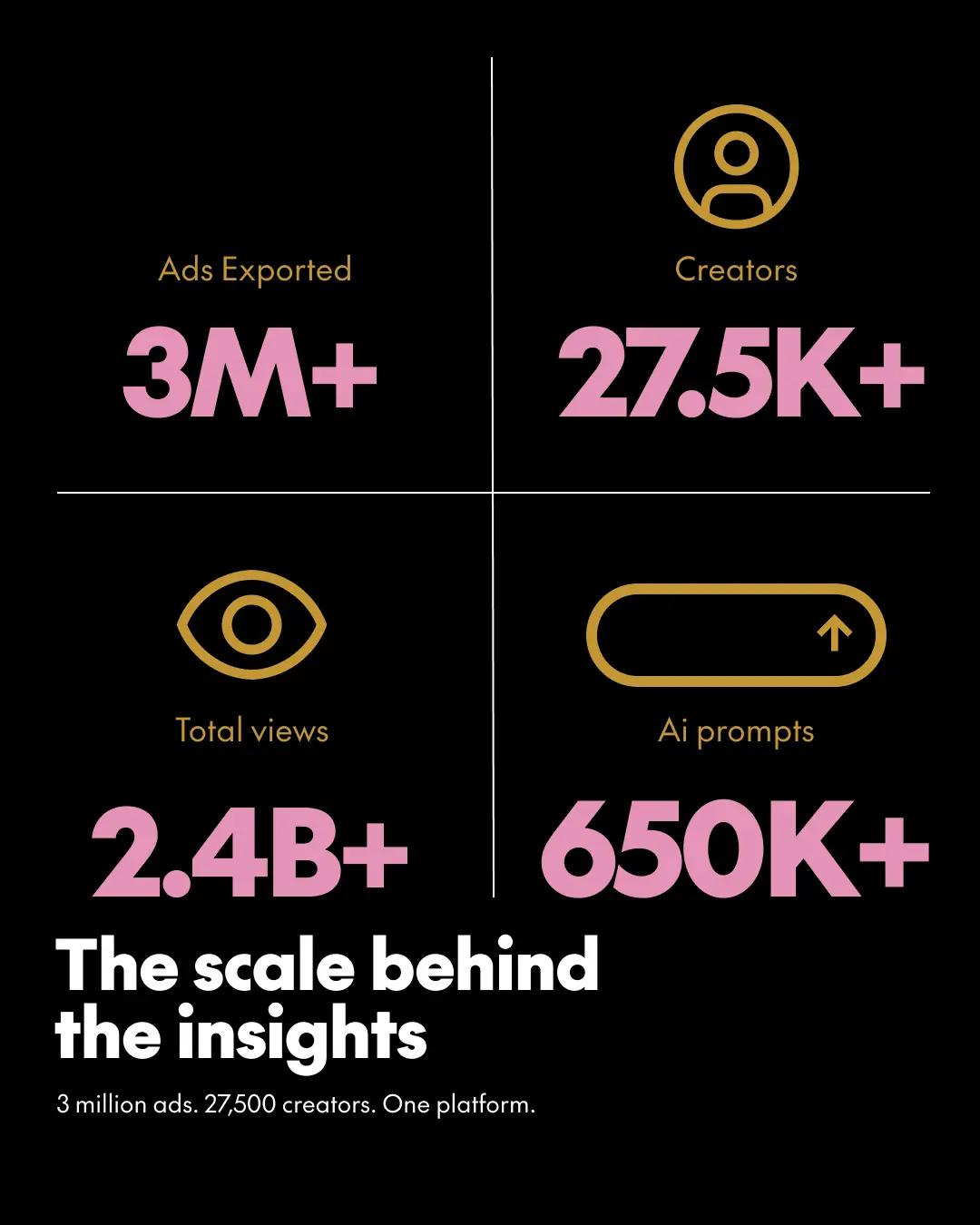
- 24,000+ ad-served designs (that received 100+ views).
- 2.4B+ views and 10.7M clicks across those creatives.
- 3M+ exported ads
- ~650,000 AI prompts
- Activity from 133 countries, representing thousands of brands, agencies, and marketing teams.
The majority of these campaigns were run by professional marketers, often using ad-serving platforms such as Google Ad Manager, Google Ads, DV360, Adform, StackAdapt, and others—so the dataset reflects serious performance and brand advertising, not casual or UGC-only use cases.
Trend 1: The attention crash
More impressions, fewer clicks, smarter pipes
Between 2024 and 2025 a shift shows up clearly:
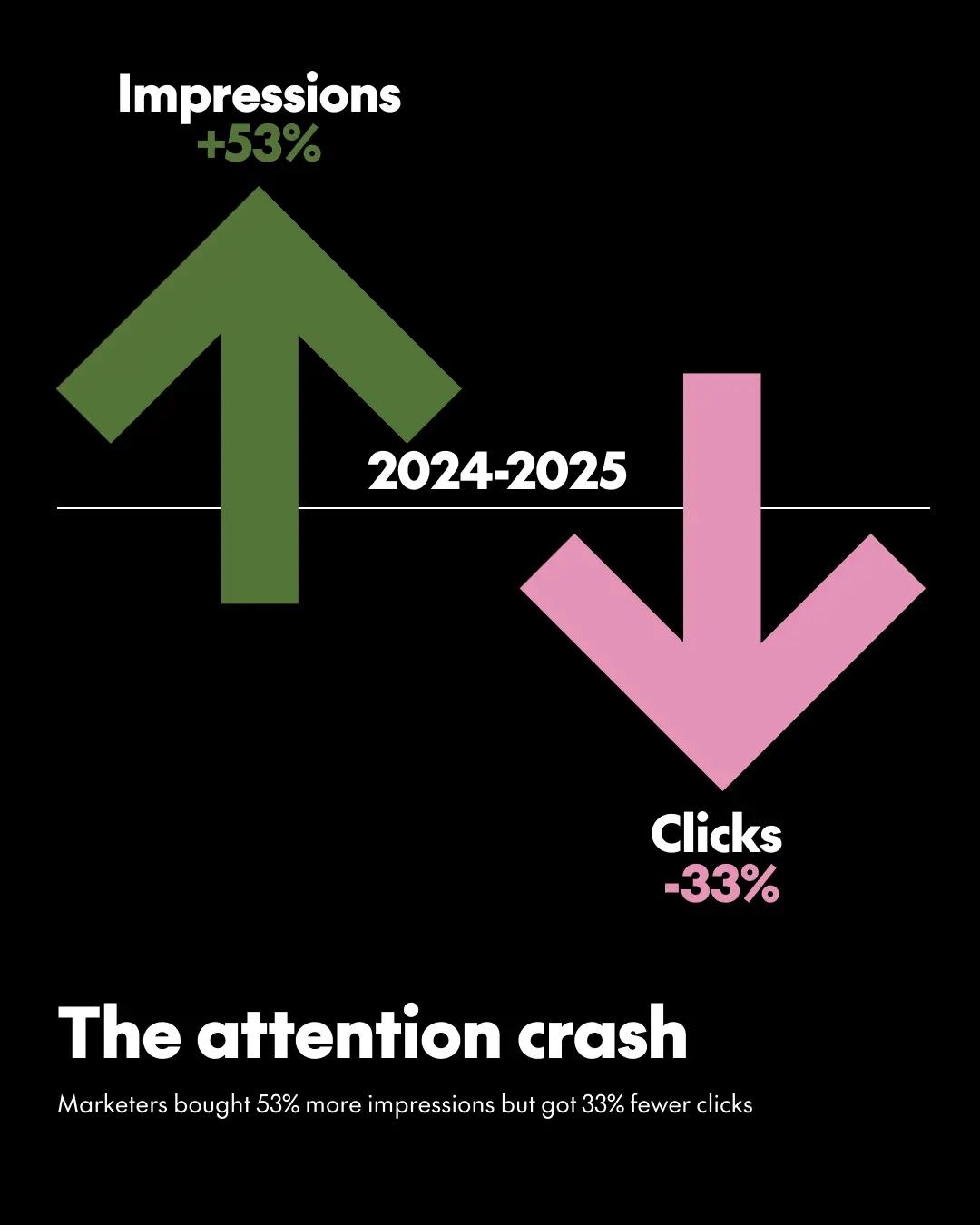
- Impressions on ads created through The Brief grew by 53% (from roughly 948M to 1.45B)
- Clicks moved from about 6.4M to 4.3M
This pattern mirrors what marketers are seeing across major ad platforms as inventory expands faster than consumer attention, and should be read as a market-wide dynamic rather than a platform-specific performance issue.
Marketers are buying more reach and producing more assets, yet each impression is worth less than a year ago. We call this the attention crash, which isn’t a new concept in advertising, but it has intensified due to a fundamental problem of supply and demand: while the total time consumers spend engaging with media has barely grown, the sheer volume and diversity of content available has exploded.
The result is a fragmentation of collective focus, driven by constant media multitasking—where an overwhelming majority of consumers routinely browse apps while watching TV or streaming. In this environment, digital media often commands a massive share of consumption time but a smaller share of revenue, reinforcing a simple truth: it’s the quality of attention, not just the quantity of impressions, that drives monetization.
Smarter pipes, tougher environment
At the same time, the major ad platforms are quietly upgrading the “pipes” that deliver ads.
Meta’s new GEM (Generative Ads Recommendation Model) is a good example: a foundation model at the heart of Facebook and Instagram’s ad system that better understands both creatives and user behavior, then uses that understanding to decide which ad to show, to whom, and when. Early results from Meta point to conversion lifts at the same budget, thanks purely to smarter delivery.
This shift matters for two reasons:
- Targeting and delivery are increasingly automated. Systems like GEM are taking over more of the optimization work that used to be done with manual targeting and bid tweaks.
- Creative becomes the primary variable you control. As the pipes get smarter and more uniform, the differentiator is the quality, clarity, and diversity of the assets you feed into them.
The data behind this report shows that even with more intelligent delivery systems coming online, rising impressions have not stopped CTR from dipping. Smarter pipes help, but they do not fix weak, repetitive, or slow-moving creative.
What this means for 2026
In 2026, performance depends on how well you engineer creative for these smarter systems:
- Plan for many more “shots on goal.” Treat creatives as a portfolio of bets that recommendation models like GEM can evaluate and redistribute spend across, rather than relying on a handful of hero ads.
- Increase variation within clear guardrails. Use creative automation and AI ad generation tools like The Brief to generate structured sets of product photos, video concepts, and copy variations that stay on-brand while giving platform models more to learn from.
- Tighten the learn–iterate loop. Use Optimize inside The Brief to read performance signals quickly, then feed winning patterns back into Create, your templates, and your AI workflows.
- Design ads for machine understanding as well as human appeal. Clear product focus, legible offers, and strong visual hierarchy help both people and models like GEM understand and match your ads faster.
Attention is getting more expensive. Platform AI is getting smarter. The teams that win are the ones that pair those smarter pipes with a creative engine designed to learn and adapt at the same pace.
Trend 2: Micro-campaigns and mega-hits
The power law of creative performance
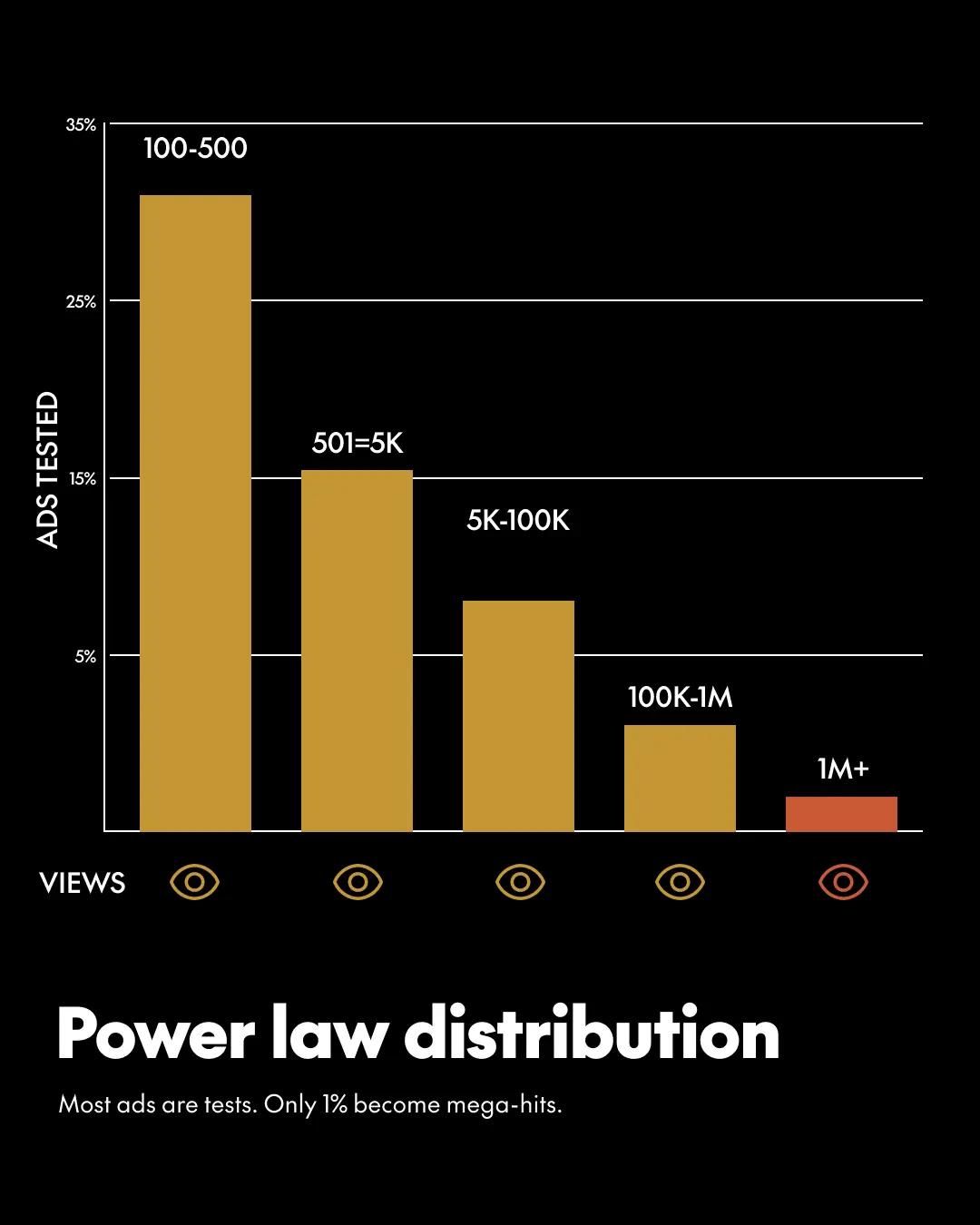
When we look at how campaigns actually distribute across view counts, performance follows a power-law curve: The share of creatives with 100–500 views jumped from 18.1% in 2024 to 31.4% in 2025. At the other end of the spectrum, only around 1–2% of creatives each year exceed 1M views, a tiny group of “mega-hits” doing the heavy lifting while most ads remain small tests.
Most ads today are effectively test cells—small experiments with limited exposure. A tiny fraction of breakout winners does the heavy lifting for brand reach and performance.
Why this matters
This shift has two big implications:
- Testing is the default, not the exceptionMarketers are running many more small campaigns to probe audiences, messages, segments, and placements.
- Scale belongs to the winners, not the averageBecause performance is so skewed, the path to better ROAS isn’t squeezing incremental gains from the median ad, it’s systematically finding and backing your top 1–5% creatives.
How to optimize your ads in 2026
- Design for experimentation: Plan creative concepts in families (10–20 variants per concept) instead of one-off assets.
- Standardize your learning framework: Treat micro-campaigns as structured experiments with clear hypotheses (hook, offer, audience, format).
- Create “promotion criteria” for ads: Define what performance a creative must hit at low spend before you scale it into a bigger campaign.
Trend 3: Creative MVPs inside every brand
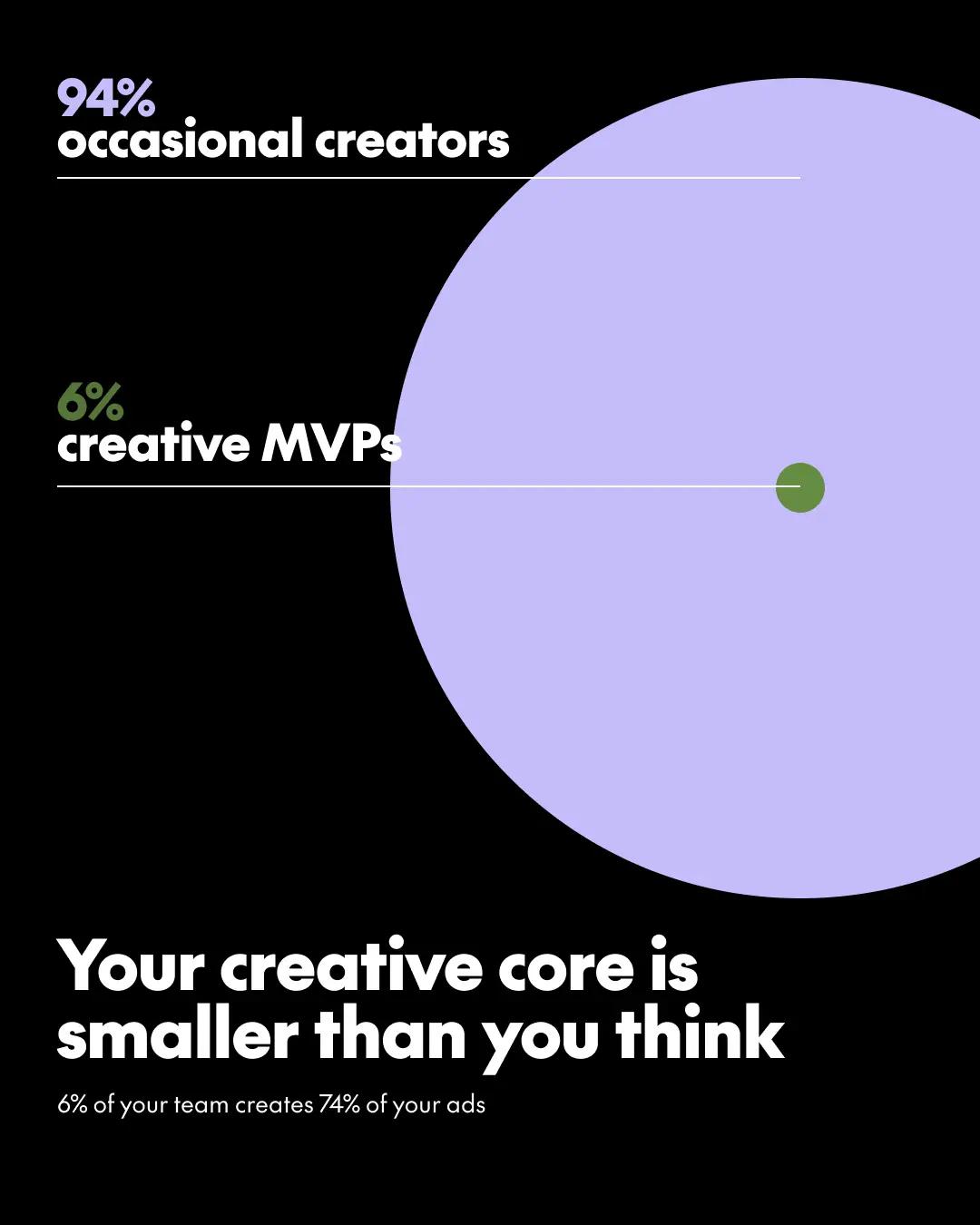
6% of marketers create 74% of ads
Ad creation is not evenly distributed. Across 3M+ ads analyzed:
- 27,500+ users created them.
- Just 6%—the heavy users—were responsible for 74% of ads.
These Creative MVPs are the power users: creative ops leads, in-house designers, performance marketers, agency partners. They:
- Build and maintain templates.
- Produce the majority of campaign variants.
- Translate briefs into assets across formats and markets.
Why this matters
Your media performance depends disproportionately on a small core of makers.
When these teams are under-resourced, misaligned, or stuck in manual workflows, everything slows down—experimentation, learning, and optimization.
How to optimize your marketing output in 2026
- Identify your Creative MVPs Look at who actually creates and exports the most assets each quarter. That’s your creative core.
- Design your stack around them Give them template libraries, AI assistance for co-creation, and automation for repetitive tasks (resizing, localization, format adaptation), so their time goes into concepts and testing, not production drudgery.
- Measure creative ops, not just media Track creative cycle time (brief → live), number of variants per concept, and time-to-first-learning as aggressively as you track CTR and CPA.
Trend 4: Product photography and video are the hero AI use cases
Across the AI prompts we looked at in 2025 on The Brief:
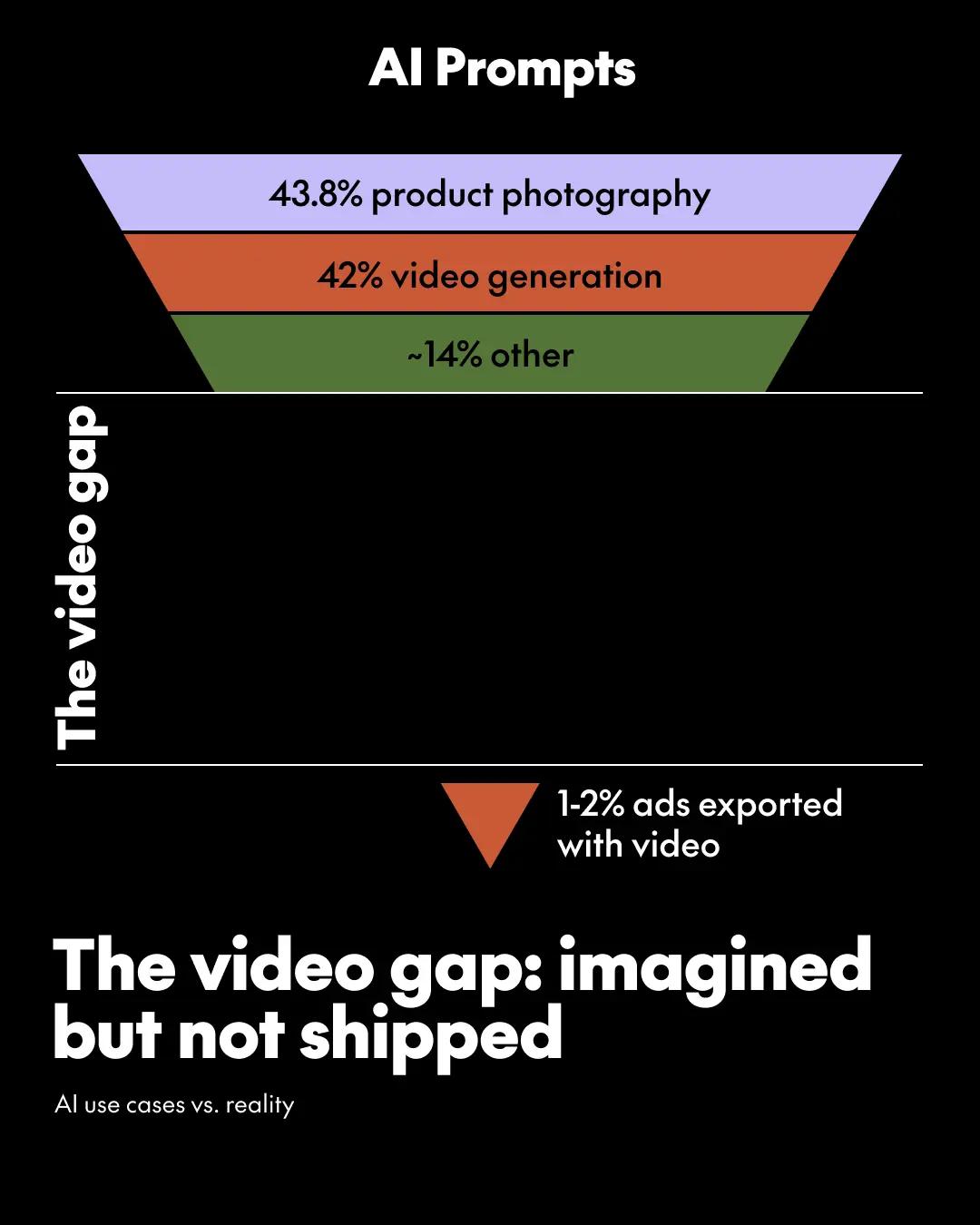
- Product photography accounts for ~43.8% of prompts.
- Video generation accounts for ~42%.
Together, they make up over 80% of AI activity in The Brief, yet only ~1–2% of exported creatives use video clips. With the cost of AI image and video generation collapsing, we expect teams to lean much harder into video in 2026, especially for product-led and performance campaigns.
Why video matters: Across major platforms, multiple benchmarks show that video ads typically drive meaningfully higher CTR and engagement than static images (often in the 20–30%+ uplift range), and in some cases dramatically lower CPC, while static image ads can still win on simple, bottom-of-funnel offers. The opportunity is to test both formats at scale and let the data, not format bias, decide.
How to improve video output in 2026
- Standardize AI product photography with Create + templates for ecommerce, catalog and promo campaigns, aligned through shared moodboards.
- Set a concrete video goal (for example, “10–20% of creatives include motion”), and use The Brief’s Veo 3, and Sora integrations to turn static winners and moodboard concepts into short videos and loops.
- Close the loop with Optimize to see which product shots and video styles perform best, then bake those patterns back into your prompts, templates, and moodboards so every new batch of creative gets smarter.
Trend 5: Motion leads
Animation > static
Across exported ads:
- ~58% of designs are animated,
- ~42% are static.
Year-over-year:
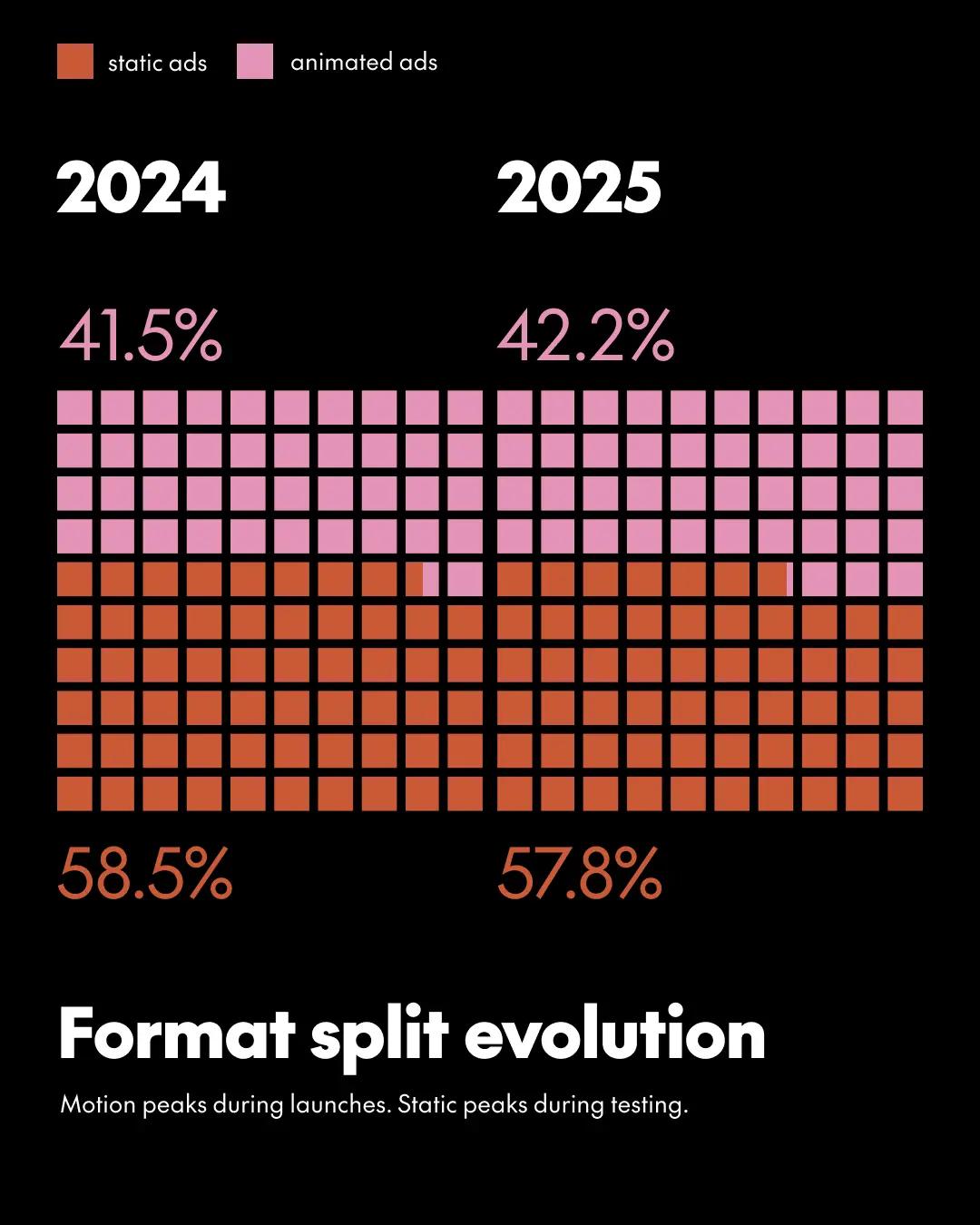
- 2024: 58.5% animated / 41.5% static
- 2025: 57.8% animated / 42.2% static
Seasonality adds nuance:
- Animated share peaks during major commercial periods (e.g., March 2024, September & November 2025).
- Static share peaks in October 2024 and July 2025, often around iterative testing and evergreen campaigns rather than tentpole moments.
How to optimize ad formats in 2026
- Think in motion + static pairs For each concept, plan at least one static and one animated variant. Use static for rapid testing and retargeting, animation for key campaigns and brand narratives.
- Prioritize motion for tentpole campaigns Use your biggest moments (product launches, seasonal pushes, promos) to invest in higher-complexity animated or video assets.
- Lean on templates for scale Templates remain almost universal (100% of 2024 designs and ~95% of 2025 designs start from templates), which is how Creative Engines keep up with demand.
- Build format-agnostic template systems that make switching between static and motion trivial.
Trend 6: Cinematic minimalism as the dominant aesthetic
When we zoom into the language of prompts and themes, 2025 had a very specific creative “vibe”:
Top creative themes include:
- Premium product visual storytelling
- Luxury fashion editorial with cinematic realism
- Modern minimalist logo and brand design
- Playful animal comedic illustrations
- Modern tech startup visual identities
Common keywords and descriptors:
- “modern,” “soft,” “white background,” “professional lighting,” “atmosphere,” “scene.”
Taken together, 2025 was the year of cinematic minimalism:
- Clean, elevated compositions.
- High-end product focus.
- A blend of luxury and humor (e.g., fashion editorial aesthetics next to comedic animal ads).
How to prompt hack your ads in 2026
- Layer techniques, don't just list adjectives
Combine the established keywords with advanced cinematic and compositional terms to force a specific mood. Instead of "modern product on white background," engineer:
"Medium shot of a [product], isolated on a textured cream backdrop with dramatic Rembrandt lighting, capturing a moment of quiet use. Cinematic, hyper-detailed, atmospheric."
- Direct the "scene" with precision
The keyword "scene" was a starting point. In 2026, define it. Specify the camera angle, shot type, and lighting to control the narrative focus.
"Low-angle hero shot of sustainable sneakers on polished concrete, morning light streaming in from a window, shallow depth of field. Clean, premium, confident."
- Fuse the luxury-humor dichotomy intentionally
The blend of high-end aesthetics with playful elements was a key 2025 insight. Hack this by making the contrast the explicit prompt strategy for memorability.
"Luxury fashion editorial photoshoot of a cat in a tailored blazer, leaning against a minimalist marble wall, looking unimpressed. Cinematic realism, Vogue style, deadpan humor."
By treating your prompt as a director's brief, you transform the overarching trend of cinematic minimalism into a consistent, ownable and highly effective ad language for the year ahead.
133 countries, distinct fingerprints
Creative activity on The Brief spans 133 countries, with a strong concentration in United States, Germany, India, France and United Kingdom.
These five markets account for ~70% of prompt activity, but the long tail includes early adopters in 100+ smaller markets (from Seychelles to Malawi), proving that AI-driven ad creation is truly global, not just Western-centric.
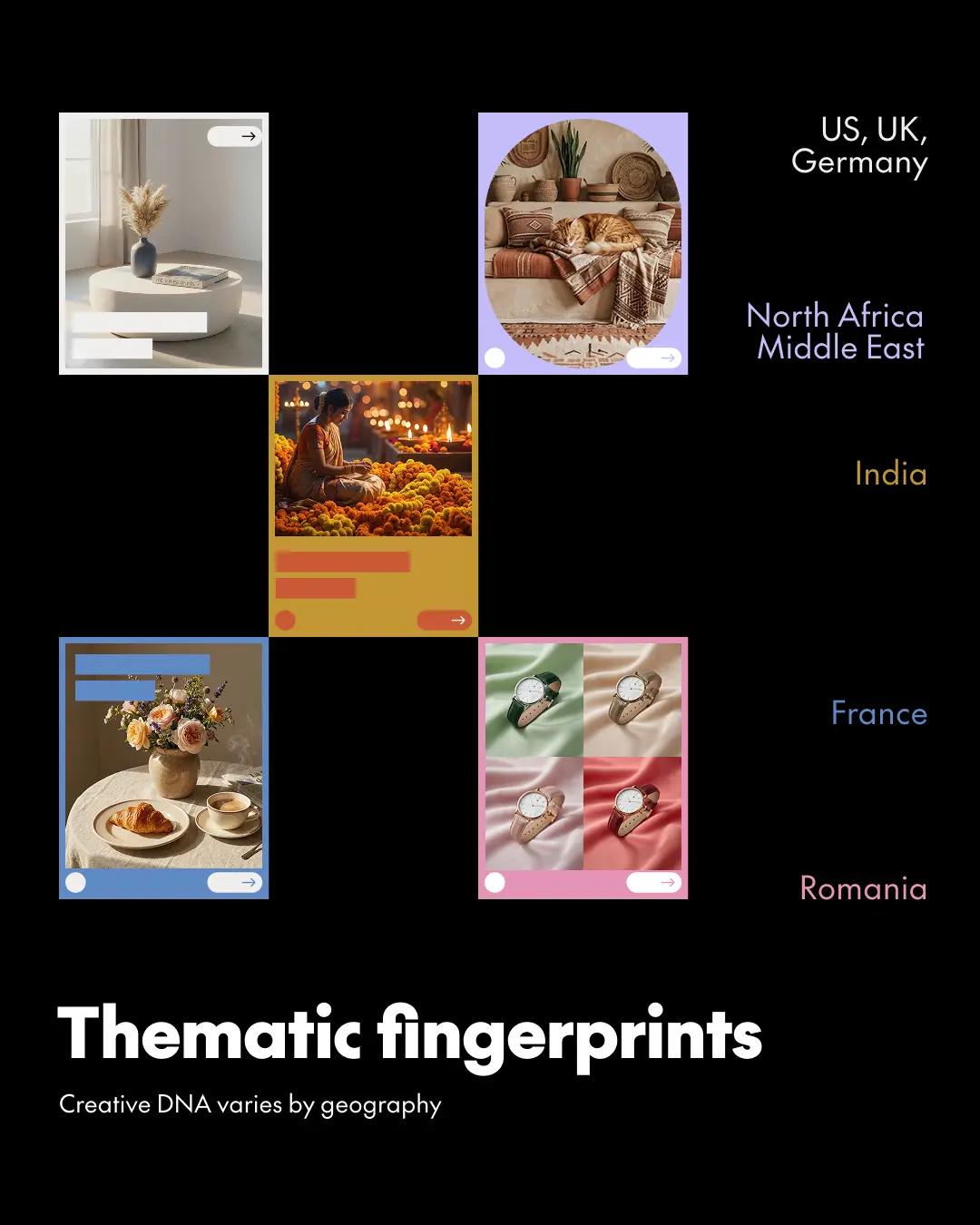
Thematic “creative fingerprints” by region include:
- U.S., Germany, UK – Minimalist layouts, sleek product photography, LinkedIn and social ad formats.
- India – Festive themes (Diwali, celebrations, vibrant color palettes).
- North Africa / Middle East – Lifestyle interiors, bohemian and design-driven visuals.
- France – Aesthetic, lifestyle, and food-oriented imagery.
- Romania – Heavy product photography and test-variation usage (a surprising AI-creative hotspot).
How to optimize your ads globally in 2026
- Localize more than the language Adapt visual cues, festivities, and aesthetics, not just copy. Use AI to generate region-specific scenes, environments, and cultural motifs.
- Use global templates, local prompts Keep structure (layouts, components, brand elements) consistent, but parameterize imagery, objects, and references per market.
- Watch emerging creative hubs Markets like Romania and India are punching above their weight in AI usage. They’re often where new workflows and aesthetic experiments emerge first.
The new creative advantage
The data from 2024–2025 is unambiguous:
- Impressions are growing faster than clicks.
- Micro-campaigns are multiplying, while only a small fraction of ads become true breakouts.
- AI work is concentrated in product photography and video prompts, but most shipped creatives are still static.
- A small group of team members (aka Creative MVPs) inside each org produces most of the output.
At the same time, platform models like Meta’s GEM and Google’s Performance Max (PMax) are making delivery and targeting smarter and more automated. These AI-driven systems require a constant flow of diverse, high-quality assets to function optimally. The real performance lever in 2026 is the quality, variety, and pace of creative production, and how quickly you can learn from it—across both static and video.
That’s where The Brief comes in. It acts as the creative engine behind your ads:
In 2026, the edge belongs to teams that run this loop well—generating more on-brand ideas, testing static and video side by side, and using data to refine every cycle. Here’s to mastering AI ad creation in 2026!