

Creatopy is now The Brief.

Creatopy is now The Brief.

TL;DR: Interactive ads respond to user actions: clicks, hovers, swipes, taps creating two-way experiences that drive 3x the engagement of static banners. This guide covers the main types (HTML5 animated, rich media, shoppable, gamified, video), explains how they work technically (HTML5, interaction triggers, DCO, AI), presents the performance evidence, and gives you a 7-step checklist for getting started. If you're still running static display, the data says it's time to switch.
Interactive ads let users click, hover, swipe, and engage directly with ad content, driving 3× more engagement than static banners. Here's everything marketers need to know in 2026.
Interactive ads are digital advertisements that invite users to actively engage with the content rather than passively view it. Instead of a static image or a simple animation, interactive ads respond to user actions — clicks, hovers, swipes, taps, or even voice commands, creating a two-way experience between the brand and the viewer.
If that sounds like a niche format reserved for big-budget campaigns, think again. Interactive ads have quietly become the baseline expectation in digital advertising. With static banner click-through rates stuck at around 0.12% and 78% of users admitting they ignore traditional banners entirely, the shift toward interactive formats isn't a trend, it's a correction.
This guide breaks down what interactive ads are, the different types available, why they consistently outperform static formats, and how to start creating them — whether you're a designer, an agency, or a brand team.
Whether you’re exploring interactive formats for the first time or looking to scale what’s already working, understanding the landscape, the formats available, the mechanics behind them, and the results they deliver — is the first step toward making smarter creative decisions.
The numbers tell a clear story. Interactive display formats generate roughly 3× the engagement of standard display ads. Rich media ads achieve a click-through rate of 0.44% compared to 0.12% for static banners — a 267% improvement. Interactive video ads reach completion rates of 91%, far above what traditional video ads deliver.
But the real shift in 2026 isn't just about performance metrics. Three structural changes in the advertising landscape have made interactive formats essential rather than optional.
As third-party cookies lose relevance — 71% of publishers now prioritize first-party data — and privacy regulations tighten, the targeting advantages that once separated good campaigns from great ones are shrinking. Platforms like Meta and Google increasingly rely on broad targeting and algorithmic delivery, which means the creative itself carries more of the performance burden. In 2026, media buying skill alone won't create competitive advantage — creative quality will. And interactive creative consistently outperforms static across every meaningful metric. According to recent industry analysis, creative-level performance differences now far outweigh audience-level differences in determining campaign outcomes.
The IAB and MRC released updated attention measurement frameworks in 2025, emphasizing time-in-view and engagement depth over raw exposure. Ads that hold attention longer correlate more strongly with brand recall and conversions than ads with higher reach alone. Interactive formats are built for this shift — they naturally extend time spent with an ad. BrightLine data shows interactive CTV ads generate an average of 71 additional seconds of viewer time compared to standard pre-roll. Gen Z audiences spend 47% more time with interactive formats compared to non-interactive ones.
According to an Infolinks study, banner blindness is widespread: 60% of users cannot recall the last display ad they saw, and only 14% can name the brand or product. Static banners aren't underperforming — they're becoming invisible. Interactive formats break through this blindness by requiring active participation, which creates stronger memory encoding and higher recall.
Interactive ads come in many forms, each suited to different goals and platforms. Here's a breakdown of the most common formats in 2026.
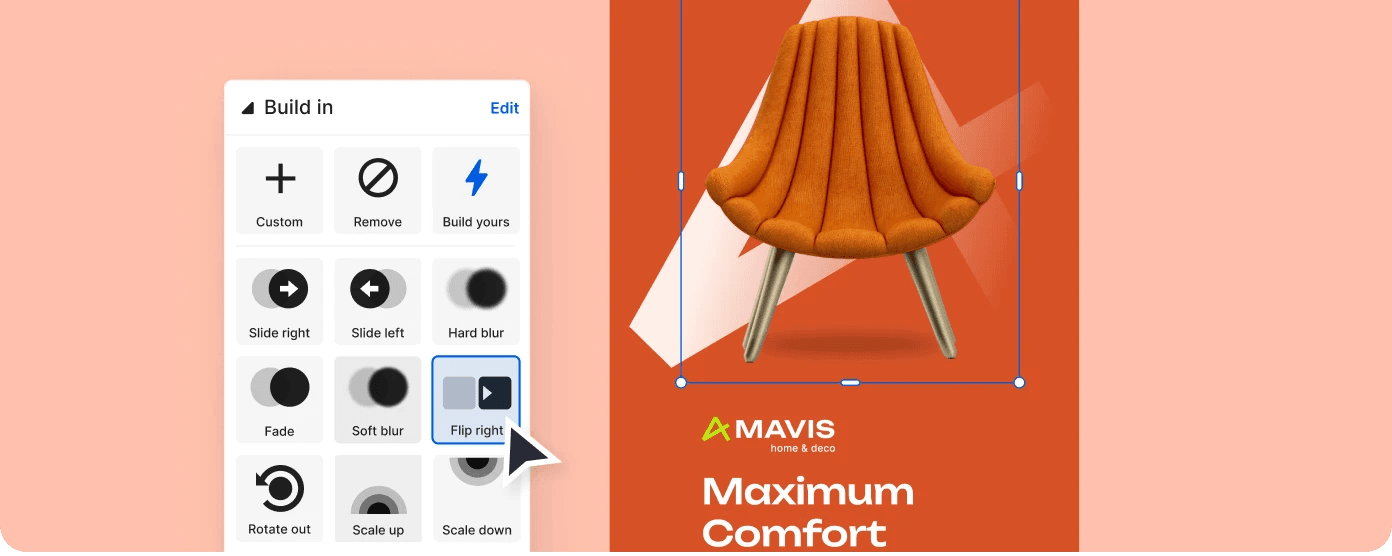
These are the evolution of the classic display banner. Instead of a static image, animated HTML5 banners use motion, transitions, and sequenced storytelling to capture attention within the ad unit. They run natively in browsers without plugins and are compatible with all major ad networks and DSPs including Google DV360. Animated HTML5 banners achieve nearly 8× the engagement rate of traditional display — 16.4% compared to just 2.1% — and consistently deliver higher click-through rates than static banners across campaigns. Tools like Ad Studio let you build these with a visual timeline editor. No code required.
Rich media ads go beyond simple animation. They include expandable units, floating ads, and multi-panel formats that can contain video, audio, interactive galleries, and data-driven elements within a single ad unit. The IAB defines rich media as ads that use advanced technology to create an interactive experience. These formats deliver a CTR of 0.44% — more than triple the static benchmark — and they support features like product carousels, embedded forms, and live data feeds.
Expandable ads start as a standard banner size and expand to a larger format when the user clicks or hovers. They bridge the gap between standard display and full rich media experiences, allowing brands to present initial messaging in a compact footprint while offering deeper content for engaged users. Expandable ads commonly appear on premium publisher sites and support video, galleries, and interactive forms within the expanded view, making them ideal for lead generation and narrative-driven brand storytelling without taking up the entire screen.
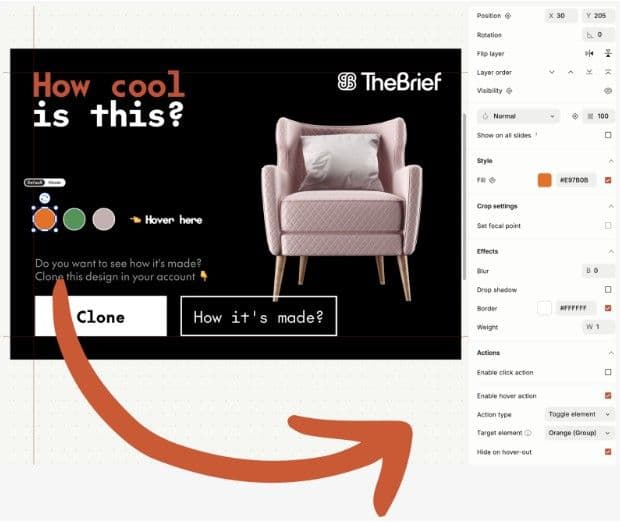
Hover ads activate when a user moves their cursor over the ad unit. The interaction might reveal additional product details, swap between color variants, expose a call-to-action panel, or trigger a video preview. Hover interactions represent a middle ground between passive viewing and active clicking — they respect user agency while driving significantly higher engagement. Research shows hover ads generate a 47% lift in time spent with the ad and are 9× more impactful on purchasing decisions compared to standard formats.
This format is particularly effective for product-focused campaigns. For example, a furniture brand could display a chair that changes color as the user hovers over different swatches, or an e-commerce ad could reveal pricing and a “Shop Now” button on hover. The interaction feels natural and low-commitment, which is precisely why it works. Platforms like The Brief have recently introduced dedicated hover action capabilities that let designers build these interactions directly in their editor — selecting a target element, defining hover-in and hover-out behaviors, and previewing the result in real time, all without writing a single line of code.
Click-to-reveal ads require the user to take an action — tapping, hoverig or clicking — to uncover hidden content. This could be a "Learn More" button that reveals product specifications, a before-and-after comparison toggle, or a multi-layer reveal that exposes additional options when hovering or clicked.
The toggle mechanic is especially powerful for storytelling within a single ad unit. Rather than requiring multiple slides or complex workarounds, a single toggle action can show and hide content, switch between product views, or even control audio playback. This reduces design complexity while creating richer experiences — brands can do more within one ad frame instead of building multiple versions.
Shoppable ads collapse the distance between seeing a product and buying it. Users can browse product catalogs, view details, and complete purchases without ever leaving the ad environment. Social commerce is projected to reach $377 billion by 2030, and shoppable formats on CTV platforms are already showing 5× better conversion rates than standard video ads. In 2026, click-to-buy, swipe-to-shop, and QR-code-enabled formats are becoming standard across social, display, and connected TV. Livestream shopping, which blends live video with real-time purchasing, is accelerating this trend. Platforms are building native shoppable layers directly into their ad units, making it possible for a viewer to go from product discovery to checkout in seconds. In-ad checkout eliminates the traditional funnel entirely — there’s no landing page, no cart abandonment, just a seamless path from attention to transaction.
Gamified ads turn the ad experience into a mini-game — spin-to-win wheels, scratch-to-reveal coupons, trivia quizzes, or playable product demos. These formats tap into intrinsic motivation and create memorable brand interactions. They're particularly effective with younger audiences: 54% of Gen Z users say they're more likely to interact with immersive ad formats. Playable ads are common in mobile app promotion but are increasingly being adopted by e-commerce, entertainment, and CPG brands.
Interactive video ads layer clickable elements, branching narratives, or decision points on top of video content. Viewers might choose which product feature to explore, vote on outcomes, or click hotspots to learn more about what's on screen. Interactive video completion rates reach 91%, and the format is expanding rapidly on connected TV — CTV interactive engagement rates have doubled from about 1% to 2% per impression between 2025 and 2026.
Connected TV is one of the fastest-expanding programmatic segments, with CTV ad spending projected to reach $37.95 billion in 2026 — a nearly 15% year-over-year increase, according to eMarketer. Interactive CTV lets viewers use their remote to browse products, select options, scan QR codes, or navigate brand content directly from the TV screen. According to BrightLine data, CTV engagement per impression reached 1.94% in Q2 2025, up from 1% just a year earlier — nearly doubling year over year. MediaScience and FreeWheel research found that 71% of viewers find interactive CTV ads attention-grabbing and 75% consider them unique, well above standard mid-roll ads. Brands using interactive CTV see +36% unaided recall, +13% foot traffic, and +33% brand affinity. Advertisers included interactive features in at least 26% of their CTV ads in 2025, and that share is expected to grow significantly as measurement matures and formats like shoppable and gamified CTV ads become more standardized in 2026.
| Format | Best For | Key Metric | Platform Fit |
|---|---|---|---|
| Animated HTML5 Banners | Brand awareness, retargeting | 16.4% engagement rate | Display networks, DV360, programmatic |
| Rich Media Ads | Product showcases, lead gen | 0.44% CTR (3× static) | Display networks, premium publishers |
| Hover-to-Reveal | Product exploration, e-commerce | 9× purchase impact | Desktop display, programmatic |
| Click-to-Reveal / Toggle | Storytelling, product details | Extended time-on-ad | Display, social, rich media |
| Shoppable Ads | Direct response, e-commerce | 5× conversion vs. video | Social, CTV, display |
| Gamified / Playable | Engagement, app promotion | 54% Gen Z interaction lift | Mobile, social, display |
| Interactive Video | Brand storytelling, CTV | 91% completion rate | CTV, YouTube, social |
| Expandable Ads | Lead gen, brand storytelling | High interaction depth | Premium publishers, display |
| Interactive CTV Ads | Brand awareness, product discovery | 2% engagement/impression | CTV platforms, streaming |
Understanding the types of interactive ads is one thing. Understanding how they're built and delivered is what separates strategic decisions from surface-level knowledge.
Most interactive display ads are built using HTML5 — the standard markup language for the web. HTML5 replaced Flash as the foundation of rich media advertising and allows ads to run natively in any modern browser without plugins. HTML5 ads can include animations, video, audio, interactive elements, and data-driven content while remaining lightweight enough for programmatic delivery, which accounts for 90% of display budgets by 2026. Google Ad Manager, DV360, and nearly every major ad platform accept HTML5 creative.
Did you know that TheBrief supports HTML5 exports, compatible for more than 40 DSP networks?
Every interactive ad is built around triggers — user actions that initiate a response. The most common triggers include click or tap (the user actively selects something), hover (the user moves their cursor over an element, activating a response without clicking), swipe (on mobile, the user drags to browse or reveal content), scroll (the ad responds to the user's scrolling behavior on the page), and time-based triggers (elements animate or change after a set duration).
In more advanced implementations, a single ad unit can combine multiple triggers. A hover action might preview a product, a click might toggle detailed specifications into view, and a swipe might let the user browse color variants — all within one creative.
Hover triggers deserve special mention because they activate on cursor proximity without requiring a click, making them lower-friction and more accessible for casual interaction. Toggle mechanics let users show and hide content layers within a single ad frame — revealing product specs, switching between before and after views, or controlling audio playback. These mechanics reduce the need for multi-slide workarounds and let designers pack more storytelling into a single ad unit, delivering richer experiences without increasing production complexity.
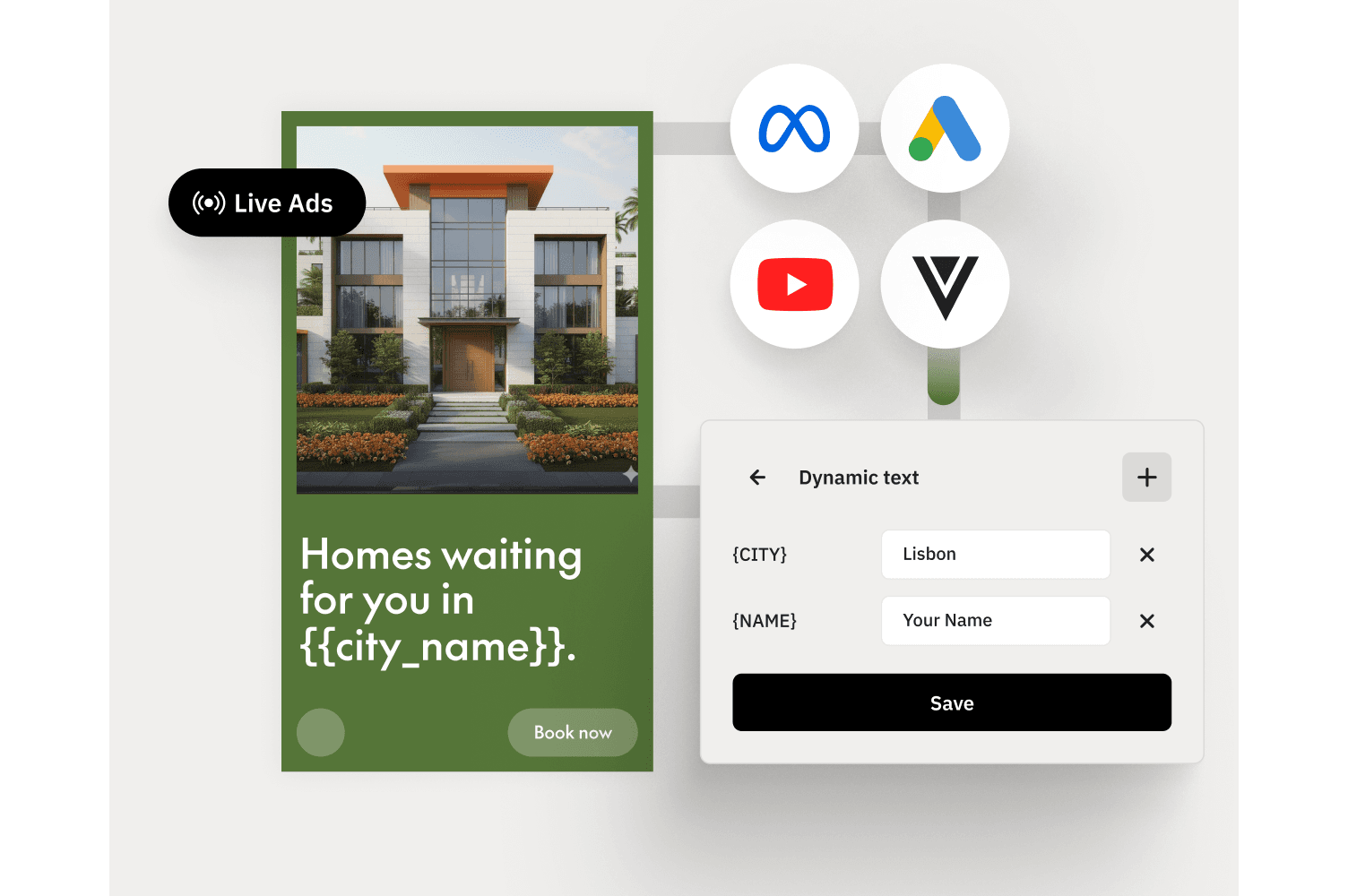
DCO takes interactive ads a step further by personalizing the content in real time. Rather than serving the same creative to every user, DCO systems swap headlines, images, CTAs, product data, pricing, and even language based on signals like the viewer's location, browsing behavior, time of day, or device type. DCO campaigns deliver a 34% increase in CTR over static ads and can improve conversions by 50–120%. The DCO market is valued at roughly $0.9–1.5 billion in 2024 and is projected to reach $1.9–4.2 billion by 2032, growing at a CAGR of 10–15%.
AI has moved from an enhancement layer to the core engine behind modern ad production, with 60% of marketers now using AI daily according to Social Media Examiner's 2025 report. AI powers several aspects of interactive ad creation including generating ad variations at scale, predicting which creative elements will perform best before launch, automating resizing and reformatting across dozens of platform specifications, optimizing bids, audiences, and creative in real time, and reducing average ad creation costs by 82% compared to 2023.
The gap that remains is in interactive-specific AI tooling. While most AI ad platforms focus on static and video creatives, tools that can generate hover interactions, toggle mechanics, and rich media experiences using AI are still emerging — making this one of the most significant capability gaps in the market right now. Looking ahead, 31% of marketers say they want to use AI predictive models to forecast ad performance before launch, and 40% wish they could pre-test creative concepts with synthetic audiences. As these capabilities mature, AI won’t just speed up production — it will fundamentally change how creative decisions are made, shifting from gut instinct to data-driven prediction.
The performance gap between interactive and static ads isn't marginal — it's structural. Here are the key data points that make the case.
These aren't incremental improvements. They reflect a fundamental difference in how users process passive versus participatory experiences. When someone interacts with an ad — even something as simple as hovering to reveal content — they form a stronger memory trace than when they passively scroll past a static image.
Interactive ads deliver better results, but they come with real production and operational challenges that teams need to plan for.
41% of marketers say it still takes 3–4 weeks to launch a digital campaign from asset creation to execution. Only 3.6% can go live in under a week. Interactive ads are more complex to produce than static ones, which can amplify this bottleneck. The solution is tooling that reduces the technical barrier — no-code platforms that let designers build interactive HTML5 ads without writing code, with automated resizing across formats and direct publishing to ad networks.
How is the data looking inside The Brief?
To provide context on creative velocity within The Brief, here is a breakdown of our customers' Time-to-Publish data (November 2025 – January 2026):

While 41% of marketers across the industry still report a 3–4 week timeline to launch a campaign, the data from The Brief's platform shows a dramatic acceleration:
This contrasts sharply with the industry benchmark where only 3.6% can go live in under a week, confirming that purpose-built no-code platforms effectively reduce the technical barrier and production complexity inherent to interactive ads.
Every ad platform has different specifications, file size limits, accepted formats, and measurement methods. An interactive ad that works perfectly on Google Display may need significant reworking for Meta, LinkedIn, or CTV. Unified creative management platforms that handle specification compliance and direct publishing across networks reduce this friction substantially.

Ad fatigue sets in after roughly 5–7 impressions of the same creative, which means teams need to produce high volumes of variations. Interactive ads can partially mitigate this through dynamic elements — a single ad template with hover reveals, toggleable content, and DCO-driven personalization can feel fresh across multiple exposures because the user's own interaction creates variety.
42% of marketers cite measuring accurate ROI as the most significant challenge in display advertising. Interactive ads actually improve this situation by providing richer engagement data — not just impressions and clicks, but hover rates, interaction depth, toggle actions, video play rates, and time-on-ad. The shift toward attention-based metrics benefits interactive formats, which generate the engagement signals that modern measurement frameworks rely on.
For teams ready to move beyond static banners, here's a practical framework for getting started.
Platforms like The Brief are built specifically for this workflow — letting teams create interactive, animated HTML5 ads without code, resize across formats automatically, and publish directly to major ad networks. For teams that need to produce interactive creative at scale without adding technical overhead, purpose-built creative platforms eliminate most of the friction between idea and live campaign.
Static ads are fixed images or simple graphics that don't respond to user input. Interactive ads respond to user actions like clicks, hovers, swipes, or taps — creating a participatory experience rather than a passive one. The performance difference is substantial: interactive formats generate approximately 3× the engagement of static display and achieve click-through rates 267% higher.
Yes. Interactive ads are designed to work across devices. On mobile, tap and swipe interactions replace hover and click. Mobile will represent approximately 75% of all display ad spend by 2026, making mobile-optimized interactive creative essential for reaching most audiences.
Historically, yes — interactive ads required specialized coding and longer production cycles. In 2026, TheBrief's no-code creative platform has dramatically reduced both cost and production time. Our AI-powered tools have cut average ad creation costs by 82%, and production times have fallen by up to 70%. The ROI improvement from interactive formats — including higher CTR, better conversion rates, and lower CPA — typically more than offsets any initial production investment. For context, many teams using TheBrief report that the shift to interactive formats actually reduces their overall cost-per-acquisition, since the higher engagement rates mean fewer impressions are needed to drive the same number of conversions.
Most major ad platforms support interactive and rich media formats including Google Display Network, DV360, The Trade Desk, Yahoo DSP, Microsoft, Amazon DSP, and connected TV platforms. Here is a full list of ad networks supported by The Brief. HTML5 is the standard format accepted across these networks, though platform support varies — Meta, for example, uses its own native ad formats rather than HTML5. Specific interactive capabilities like hover effects, expandable units, and shoppable elements vary by platform.
Beyond standard metrics like impressions and click-through rate, interactive ads provide engagement-specific data including hover rates, interaction depth, toggle and reveal actions, video play rates, time-on-ad, and product exploration behavior. The IAB's updated attention measurement frameworks emphasize time-in-view and engagement depth, which are metrics where interactive formats consistently outperform static.
Hover ads are interactive ad units that respond when a user moves their cursor over the ad — without requiring a click. The hover action might reveal additional product details, change a product's displayed color, expose a call-to-action, or trigger a video preview. Research shows hover ads generate a 47% lift in time spent with the ad and are 9× more impactful on purchasing decisions. They're particularly effective for product exploration and e-commerce campaigns.
Let's put these insights into action. Build, scale, and automate campaigns with AI-powered workflows.
