Impressions grew 53% (≈948M → 1.45B), while clicks fell (≈6.4M → 4.3M) → the attention crash is real.
Most creatives are small tests while ~1–2% become “mega-hits.”
Output is concentrated: 6% of marketers created 74% of ads → your “Creative MVPs” are your throughput.
AI use is concentrated in product photography (~43.8% of prompts) and video (~42%), but shipped output is still disproportionately static.
This automation creates a new paradigm: with platforms now managing the delivery (e.g., Meta’s GEM, Google’s PMax), targeting and bids have become commoditized. The primary variable you control—and your only true competitive lever—is now creative quality, variation, and iteration speed.
The game has shifted from buying attention to earning it through rapid iteration. Since delivery is increasingly automated, competitive advantage comes from building a systematic creative engine. This shift is about engineering scalable outcomes—transforming creative production from a sporadic effort into a continuous, data-informed portfolio strategy designed to beat the attention crash.
Key actions
Move from “campaigns as big bets” to creative as a portfolio.
Treat each micro-campaign as a hypothesis test (hook, offer, format, audience cue).
Build for machine understanding + human appeal: legible offer, strong hierarchy, clear product focus.
Offer variants (percent off vs bundle vs free shipping)
Layout variants (minimal vs info-dense)
CTA variants (shop now vs learn more)
Create Agent
3. Launch with clean test structure
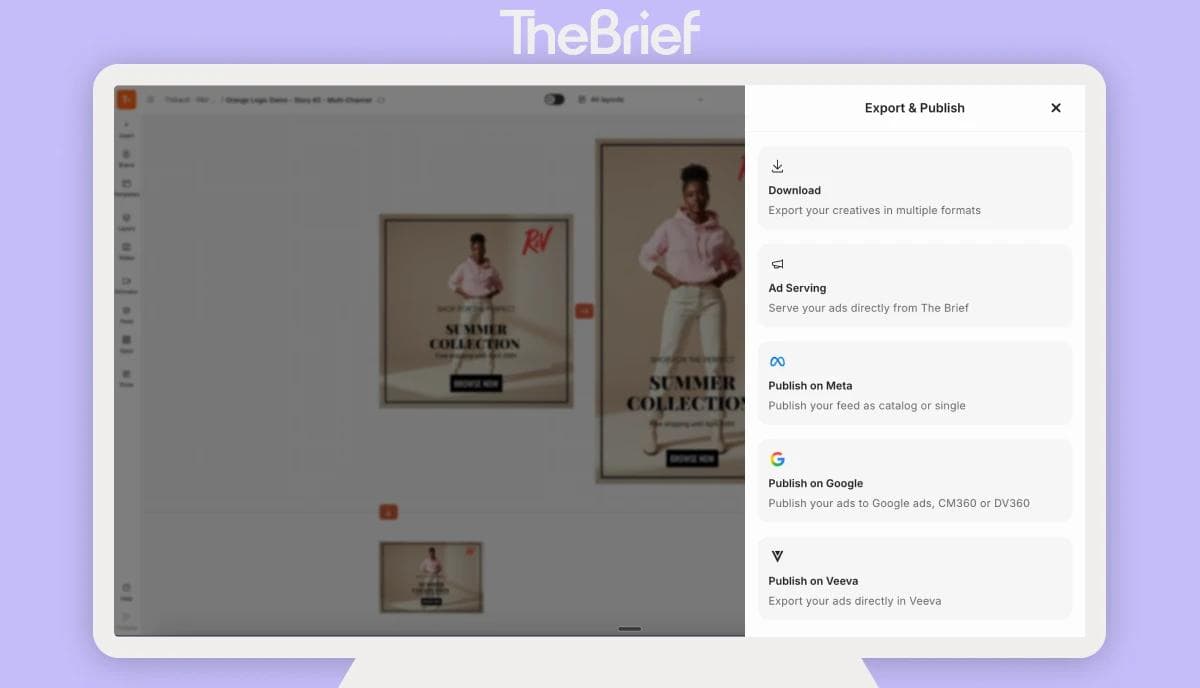
Use Export Workflows to batch-export channel-ready formats (JPG/PNG/HTML5/GIF/MP4).
If relevant, use Direct Publishing to push creatives to major ad platforms faster.
For fast iteration without re-uploading: use Ad Serving to host creatives and update them in real time.
Publish and Serve Ads
Promotion criteria:
Promote creatives that hit your target CTR/CVR/CPA threshold at low spend.
Kill or revise creatives that miss thresholds twice in a row—don’t “nurture” median ads.
Shift 2: Build your stack around MVPs
Core idea
Your creative output is a function of your most effective makers. The core idea is to architect your entire production stack around these MVPs, removing all systemic friction that wastes their talent on repetitive tasks. By automating the grind and standardizing quality, you transform their capacity into scalable throughput, accelerating your entire team's learning cycle.
Key actions
Identify your MVPs and protect their time.
Standardize what “good” looks like (templates, kits, naming).
Reduce handoffs and version chaos.
How to implement in The Brief
1. Identify and operationalize your MVP workflow
Create a dedicated workspace/project structure per brand/client.
Use roles/permissions to ensure the right people can create, edit, approve, and export.
Move AI product photography from a novel experiment to a core operational competency. The goal is to industrialize creativity by building standardized, repeatable pipelines that turn any product image into an on-brand, channel-ready asset at scale—transforming a tactical tool into a strategic system for catalogs, promos, and global campaigns.
Key actions
Build a reusable “prompt + template kit” per product category.
Generate product imagery that matches your brand aesthetic (e.g. “cinematic minimalism”), while still testing contrast/humor when relevant.
How to implement in The Brief
1. Create your product photo system
Start with a Canvas: collect examples of your favorite lighting references, backdrops, composition rules.
A “product hero” template (clean hierarchy, offer slot, CTA slot)
A “feature callout” template (benefit bullets, icons)
A “social proof” template (ratings, testimonials)
Product Photography
2. Turn prompting into a standardized asset
Store 5–10 “house prompts” by category.
Use the cinematic minimalism insight by directing camera/scene, not just adjectives. Example prompt pattern: [Shot Type] + [Lighting] + [Scene] + [Mood].
3. Scale variations safely
Use Brand Kits to keep all generated assets on-brand.
Use Live Data when you need many automated variants.
Output target: every key product gets a “photo pack” (5–15 usable images) refreshed monthly or per promo cycle.
Shift 4: Bridge the motion gap
Core idea
In a sea of static images, motion is your hook. This shift is about moving animation from the "special projects" bin to the main assembly line. By systematically pairing motion with every static concept, you build a reliable engine for breakthrough creative, ensuring you always have the dynamic assets needed to stop the scroll.
Key actions
Require motion + static pairs for each concept.
Start with low-risk motion: loops, reveals, subtle kinetic type—then graduate to full video.
Convert static winners into motion variants quickly.
How to implement in The Brief
1. Make “paired formats” a rule
For every concept family, produce:
1–2 static controls
1–2 animated variants (same message, different attention mechanic)
Use Templates designed to be “format-agnostic” so swapping static ↔ motion is trivial.
Export via Export Workflows with consistent specs per channel.
4. Make a practical commitment (easy to adopt):
“By end of Q1: 10–20% of new creatives include motion.”
Shift 5: Systematize ad experimentation
Core idea
Stop playing creative lottery. Start running a discovery lab. This shift is about replacing sporadic guesses with a regimented experimentation framework. By standardizing how you test, measure, and institutionalize learnings, you build a repeatable system that consistently finds and scales the top 1% of performers.
Key actions
Standardize test types and naming.
Define promotion criteria before you launch.
Centralize learnings so winners become templates (not trivia).
How to implement in The Brief
1. Adopt a standard test matrix
Hook test (3 angles)
Offer test (2–3 offers)
Format test (static vs motion)
Visual style test (minimal vs lifestyle vs humor contrast)
Localization test (market-specific aesthetics, not just language)
2. Launch, then measure in one place
Use Ad Serving for built-in A/B testing and easier iteration without re-uploading.
Write 1–2 sentences explaining why - so you don’t retest the same failure.
Conclusion: The system is the strategy
The 2026 reality is straightforward:
Attention is fragmenting.
Platforms optimize delivery automatically.
Creative performance is skewed (power law).
A small group of MVPs determines your output.
Motion and AI product visuals are becoming table stakes.
Your competitive advantage won’t be one viral ad. It will be a repeatable ad creation playbook—a creative engine that produces on-brand variants fast, ships them cleanly, learns quickly, and standardizes what works.
Next step: Choose one shift to implement this month:
If you’re slow: start with Shift 2 (Creative MVPs + templates + brand kits)
If you’re inconsistent: start with Shift 5 (standard experiments + Optimize loop)
If you’re stuck in static: start with Shift 4 (paired static/motion rule)
Build the loop in The Brief, and let the data—not opinions—decide what scales.




.webp%3Fw%3D1125%26fm%3Dwebp%26q%3D70%26fit%3Dmax&w=3840&q=70)
